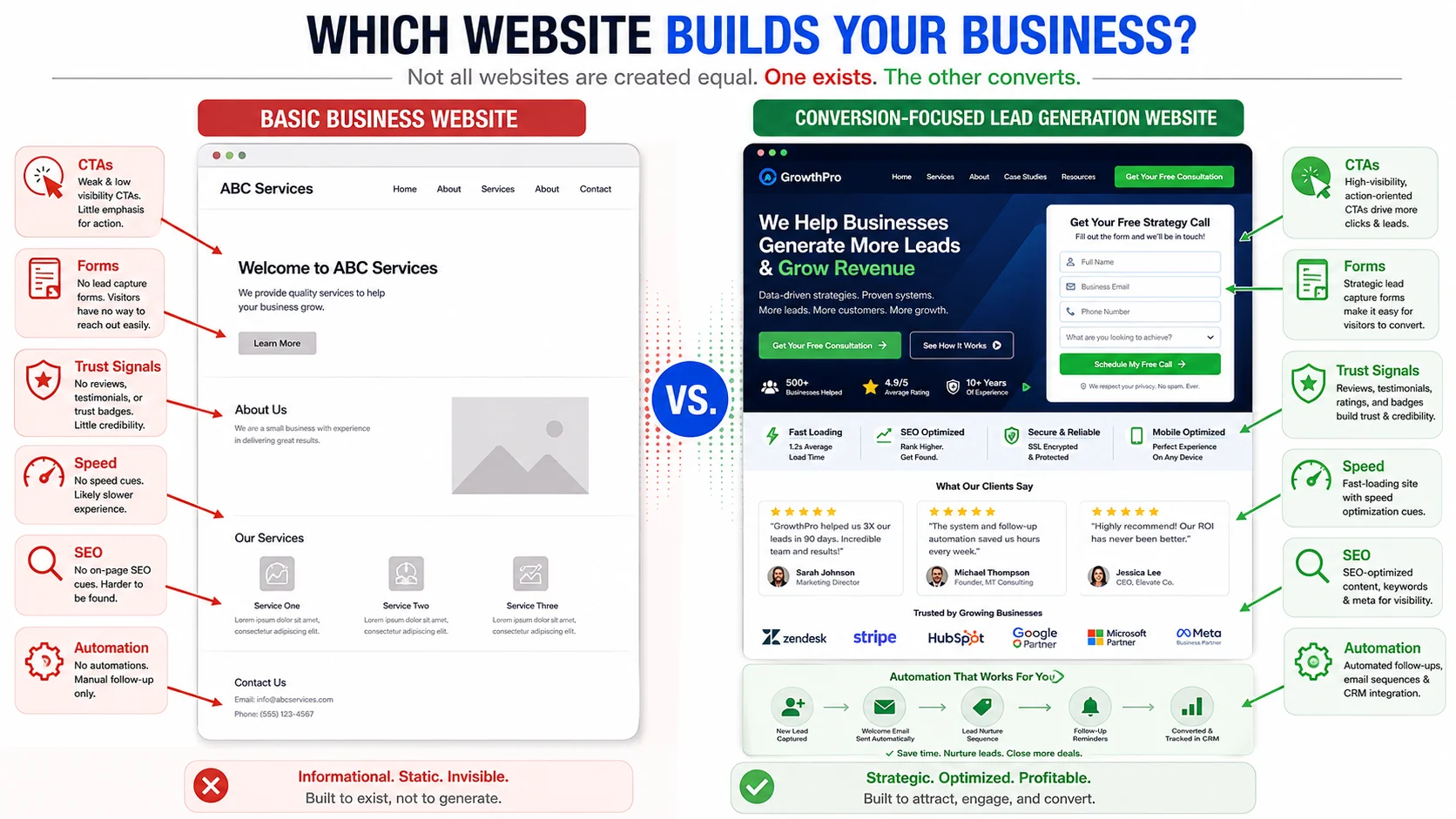
A business website should do more than look professional. It should attract the right visitors, build trust, explain your value clearly, and turn interest into inquiries, calls, bookings, or sales.
If your business website is not generating leads, the problem is usually not one single thing. It is often a mix of weak messaging, poor user experience, missing SEO foundations, unclear calls to action, slow performance, and no follow-up system.
The good news is that most of these issues can be fixed with the right digital marketing strategy and a more conversion-focused approach.
What a Lead-Generating Website Should Actually Do
A lead generation website has one clear job: move visitors from interest to action.
That action could be:
- Filling out a contact form
- Booking a consultation
- Calling your business
- Requesting a quote
- Downloading a guide
- Starting a chat
- Signing up for an offer
A website that only explains who you are is not enough. A strong business website guides visitors toward the next step with clear messaging, helpful content, trust signals, and simple conversion paths.
This is where professional website development services matter. A high-performing website is not only about visuals. It is about structure, speed, messaging, technical setup, and user experience working together.
Common Reasons Your Website Is Not Generating Leads
Many business owners assume that traffic is the only problem. Sometimes that is true, but not always. A website can receive visitors and still fail to convert them.
Here are the most common business website mistakes that stop leads.
1. Your Message Is Not Clear Enough
When someone lands on your website, they should understand three things quickly:
- What you offer
- Who you help
- Why they should choose you
If visitors have to think too hard, they leave. Confusing headlines, vague service descriptions, and generic copy can make even a good-looking website ineffective.
Instead of saying, “We provide innovative solutions,” say what you actually do and how it helps the customer.
2. Your Website Has Weak Calls to Action
A call to action tells visitors what to do next. Without it, people may read your content and leave without taking action.
Examples of strong CTAs include:
- Book a Free Consultation
- Request a Quote
- Schedule a Strategy Call
- Get a Website Audit
- Talk to Our Team
Every important page should have a clear next step. If your CTA is hidden, unclear, or only appears at the bottom of the page, you are likely losing leads.
3. Your Website Is Not Built Around User Intent
A visitor looking for pricing, examples, services, or contact information should be able to find it quickly.
Good website user experience means your pages are easy to navigate and built around what customers actually need. Poor navigation creates friction, and friction kills conversions.
A helpful structure usually includes:
- Clear service pages
- Simple navigation
- Visible contact options
- Trust-building sections
- FAQs
- Testimonials or portfolio examples
- Strong CTAs throughout the page
Website Design vs. Website Conversion
A beautiful website is useful, but beauty alone does not generate leads. Conversion rate optimization is about making every part of the website support action.

| Website Element | Weak Version | Lead-Generating Version |
| Headline | Generic and vague | Clear value proposition |
| CTA | Hidden or unclear | Visible and action-focused |
| Forms | Too long | Simple and easy |
| Navigation | Confusing | Clean and direct |
| Content | Company-focused | Customer-focused |
| Trust Signals | Missing | Reviews, portfolio, proof |
Website design for lead generation should balance branding, usability, and conversion strategy. The visitor should feel confident, informed, and guided.
Your SEO May Not Be Bringing the Right Traffic
If your website has very little organic traffic, SEO may be the issue. If your traffic is high but leads are low, the issue may be traffic quality or page conversion.
Strong SEO services help your website appear for the right search terms, not just random keywords. For example, a local business does not only need traffic. It needs visitors who are actively searching for its services.
SEO helps by improving:
- Keyword targeting
- Page structure
- Technical performance
- Local search visibility
- Content depth
- Internal linking
- Search intent alignment
For AEO and GEO, your content should also answer questions clearly. Search engines and AI-powered platforms are increasingly looking for direct, helpful answers that explain problems and solutions in a natural way.
You Are Missing Trust Signals
People do not become leads unless they trust you.
Your website should answer the silent questions visitors are asking:
- Is this business real?
- Do they understand my problem?
- Have they done this before?
- Can I contact them easily?
- Do they look professional?
- What happens after I submit the form?
Trust signals can include:
- Portfolio examples
- Testimonials
- Business contact details
- Service process
- Team information
- Case studies
- Certifications, if real
- Clear privacy and contact policies
Do not exaggerate or make fake claims. Real proof is always stronger than generic marketing language.
Your Forms May Be Hurting Conversions
A contact form should be simple. If your form asks for too much information too soon, visitors may abandon it.
For most lead generation websites, start with the essentials:
- Name
- Phone number
- Service needed
- Message field
You can collect more details later during the consultation or follow-up process.
Also, make sure your form works properly. A broken form, missing confirmation message, or slow response process can cost real business opportunities.
You Have No Follow-Up System
Generating leads is only half the job. Responding quickly is just as important.
If a visitor submits a form and nobody follows up fast, they may contact a competitor. This is where automation can support your sales process.
Tools such as AI virtual assistant solutions can help businesses respond faster, answer common questions, schedule appointments, and reduce missed opportunities.
A strong follow-up system may include:
- Instant confirmation message
- Automated email reply
- CRM notification
- Appointment booking link
- SMS follow-up
- AI chat support
- Lead status tracking
The goal is not to replace human communication. The goal is to make sure no lead gets ignored.
How to Fix a Website That Is Not Generating Leads
Start with a practical audit. Look at your website the way a customer would.
Ask these questions:
- Is the main offer clear within five seconds?
- Is there a strong CTA above the fold?
- Are service pages detailed and helpful?
- Is the website easy to use on mobile?
- Does the site load quickly?
- Are forms short and working?
- Are trust signals visible?
- Is SEO targeting the right keywords?
- Is there a follow-up system after form submission?
- Does every page guide visitors toward action?
If the answer is no to several of these, your website is likely leaking leads.
Short Summary
A business website generating leads needs more than attractive design. It needs clear messaging, strong SEO, fast performance, trust signals, simple navigation, effective CTAs, and a reliable follow-up system.
When these elements work together, your website becomes more than an online brochure. It becomes a real business growth asset.
Conclusion
If your website is not generating leads, do not assume the entire site needs to be replaced. Sometimes the biggest improvements come from fixing the right things: your message, layout, SEO, forms, calls to action, and follow-up process.
Voxlumedia helps businesses build smarter digital systems that combine website strategy, SEO, automation, and conversion-focused design. If your website is getting traffic but not enough inquiries, or if it is not attracting the right visitors at all, Voxlumedia can help you identify the gaps and turn your website into a stronger lead generation tool.
