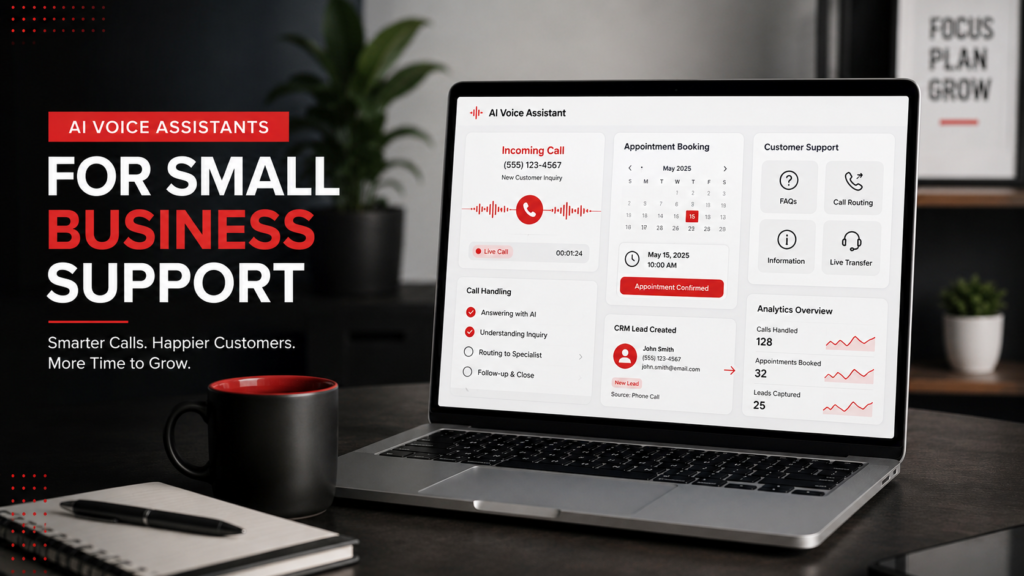
Small businesses lose opportunities every day because calls are missed, follow-ups are delayed, and teams are busy serving existing customers. For local businesses, contractors, clinics, and service providers, the phone is still one of the most important lead channels. When someone calls, they usually want help now.
An AI voice assistant for small business helps answer calls, qualify leads, schedule appointments, respond to common questions, and route urgent inquiries without making customers wait.
This does not mean replacing your team. It means giving your business extra support so every caller gets a faster, more consistent experience.
What Is an AI Voice Assistant?
An AI voice assistant is a phone-based automation tool that can speak with callers, understand basic requests, collect information, and guide the conversation based on your business rules.
It can work as an AI receptionist, AI call assistant, or phone answering AI depending on how your business uses it.
For example, an AI voice assistant can:
- Answer incoming calls
- Ask what service the customer needs
- Collect name, phone number, and location
- Book appointments
- Send details to your CRM
- Route urgent calls to a team member
- Answer common service questions
- Follow a custom script based on your business
For a small business, this creates a more reliable front desk experience without adding another full-time employee.
Why Small Businesses Need Better Call Support
Many local businesses are not losing leads because their service is bad. They are losing leads because response time is slow.
A contractor may be on a job site. A clinic team may be helping patients. A service provider may be driving between appointments. During that time, new callers may go to voicemail.
The problem is simple: customers rarely wait.
If they cannot reach one business, they often call the next one. That is why automated customer service is becoming more useful for small teams that need to stay responsive without stretching their staff.
How an AI Receptionist Helps Local Businesses
An AI receptionist gives callers an immediate response. Instead of hearing voicemail, the customer gets a guided conversation.
For local businesses, this can help with:
- After-hours calls
- Busy-hour overflow
- Appointment requests
- Quote requests
- Basic customer questions
- Lead qualification
- Emergency service routing
- Missed call recovery
This is especially useful for businesses where every call could become a sale, booking, or long-term customer.
AI Voice Assistant vs. Traditional Phone Support

A human receptionist is valuable, but small businesses often need support outside normal office capacity. An AI call assistant can fill those gaps.
| Feature | Traditional Phone Support | AI Voice Assistant |
| Availability | Limited by staff hours | Can support calls 24/7 |
| Response Speed | Depends on team availability | Immediate answer |
| Lead Capture | Manual note-taking | Structured information collection |
| Follow-Up | Can be delayed | Can trigger workflows |
| Scalability | Requires more staff | Handles more call volume |
| Consistency | Varies by person | Follows approved scripts |
The best setup is often a combination of both: AI handles routine calls and your team focuses on high-value conversations.
Common Use Cases for Service Providers
An AI voice assistant for small business can be customized by industry.
Contractors
Contractors can use phone answering AI to collect job details, service area, urgency, and preferred appointment time.
Clinics
Clinics can use AI call support for appointment requests, general questions, reminders, and call routing.
Local Service Businesses
Garage door companies, cleaning services, HVAC companies, moving companies, and repair businesses can use AI to reduce missed calls and speed up lead response.
Agencies and Consultants
Service-based teams can use AI to qualify inquiries and schedule discovery calls.
Voxlumedia’s AI virtual assistant solutions are designed to support these types of business workflows through automation, scheduling, customer support, and daily operational assistance.
What Makes a Good AI Call Assistant?
Not every AI voice system is useful. A good setup must be planned around real business needs.
A strong AI call assistant should have:
- A clear call script
- Friendly and natural language
- Lead qualification questions
- Appointment booking logic
- Escalation rules for urgent calls
- CRM connection
- Call summaries
- Follow-up automation
- Custom business information
- Testing before launch
The goal is not to sound flashy. The goal is to be helpful, accurate, and easy for customers to use.
Why CRM Integration Matters
AI call support becomes much stronger when it connects with your CRM.
Without CRM integration, call details may still need to be copied manually. With integration, the system can send lead information directly into your pipeline.
That means your team can see:
- Who called
- What service they need
- How urgent the request is
- Whether an appointment was booked
- What follow-up is required
This is where CRM automation support can help connect call handling with lead management, follow-ups, and sales tracking.
How AI Voice Assistants Improve Customer Experience
Customers want quick answers. They do not want to repeat information, wait days for a callback, or leave messages that never get answered.
An AI receptionist improves customer experience by making the first interaction faster and more organized.
It can help customers feel:
- Heard
- Guided
- Informed
- Scheduled
- Prioritized
For small businesses, this creates a more professional impression from the first call.
Practical Tips Before Setting Up AI Phone Support
Before launching an AI voice assistant, prepare your business information first.
Start with:
- Your main services
- Service areas
- Business hours
- Emergency rules
- Appointment availability
- Frequently asked questions
- Pricing guidance, if applicable
- Lead qualification questions
- Transfer rules
- Follow-up process
The better your setup, the better the customer experience.
Short Summary
An AI voice assistant for small business helps answer calls, reduce missed leads, support customers, and organize follow-ups. It works especially well for local businesses, contractors, clinics, and service providers that depend on phone inquiries.
The best results come when AI call support is connected with CRM workflows, appointment scheduling, and clear business rules.
Conclusion
Small businesses do not need more missed calls, scattered notes, or delayed follow-ups. They need a smarter way to respond when customers are ready to talk.
An AI receptionist or phone answering AI can help your business stay available, capture more opportunities, and deliver a smoother customer experience without overwhelming your team. Voxlumedia helps businesses build practical AI systems that support real operations, not just trendy technology. If your business wants to improve call handling, automate support, and reduce missed opportunities, you can book a strategy session with Voxlumedia to explore the right AI voice assistant setup for your workflow.
